
View Signal Source
The Story Behind Ultima’s Morality
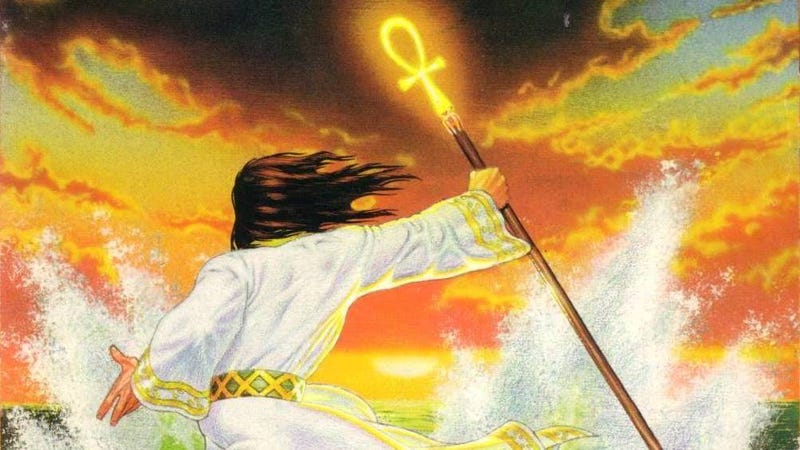
When I think back on the games I played growing up, the Ultima series stands out as one of the most unique and compelling. These open-world fantasy RPGs helped define and establish many of the standards of the genre through nine main installments and multiple spin-offs on a variety of platforms.
My first Ultima game was the third in the series, the Nintendo Entertainment System port of Exodus released in 1989, six years after the game’s initial release on Apple II. It was a difficult, but enjoyable, experience. But 1985's Ultima IV, which I played on the Nintendo as well, was the game that I fell in love with, because it went so much against the grain of a traditional RPG. There weren’t villains you had to vanquish or an evil that had to be defeated. Your main goal was to be a good person and go throughout Britannia helping people. 1988's Ultima V flipped morality on its head by pushing the virtues of the avatar into a moral absolutism that was terrifying. Further games in the series would push the boundaries of ethics, forcing players to question the binary values they’d normally associate with simpler gaming narratives.
Advertisement
Recently, I had the chance to talk via email with Richard Garriott, aka Lord British, creator of the Ultima series, about the games as well as the spiritual successor to the series Shroud of the Avatar to know more about the stories behind their development.
Grand Theft Ultima

For a lot of people, Ultima IV was the game that changed their whole perspective on the narrative possibilities of gaming. The ultimate goal of pursuing the eight virtues and becoming the avatar was so much more fascinating than the trope of fighting back some evil or saving a princess. I asked Garriott about the evolution of the game.
Advertisement
“My previous games sold well, but Akalabeth, Ultima I and Ultima II were sold through other companies,” he said. “Ultima III was the first title published by my own company, Origin. This was important, because it meant that for the first time, when someone wrote to the company about the game, the letter came to me.”
The letters would reveal a disturbing trend. “I was very surprised to see the consistent pattern of the letters people would write about their experiences with my games,” Garriott said. Generally, they would first state how much they enjoyed the games to date, but then there would be pages and pages of critiques.” Garriott hoped that players, faced with the game’s open-ended moral choices, would choose to be good. But all those letters said otherwise.
“Players loved to kill all the NPCs in all the towns and steal from all the shops, and especially to kill my character Lord British in order to level up as fast as possible to become powerful enough to kill the main bad guys in the games,” Garriott said.“That was not being very virtuous. I realized that in all three Ultimas, I had created games in which the best way to min-max the game was to be un-virtuous. Everyone was doing that in order to win as fast as possible. I was not going to allow that ever again!”
Advertisement
For Ultima IV, Garriott set out to make a game that would tempt players to take moral shortcuts. On the surface, the game would appear to allow such behavior. At the same time, there would be repercussions showing the appropriate side effects of these actions. “I set out to explore the best real moral codes I could find and began a long and deep era of personal research in philosophy and game design that manifested in Ultima IV,” he said—”its Virtues, its conversation systems, the term Avatar, the Virtues, and numerous other tropes that are now standards of gaming.”
The game’s theme of pursuing virtues appealed to many players, and this sense of differentiating itself expanded to every element of the game, including the character creation. In the opening, rather than setting classes and stats, players are shown the Cards of Virtue. They’re then asked a series of questions, almost like a psychological test, and the preferences determine the character they start with.
Advertisement
“The cards came about as a tangential way to build a character model of your ethical preferences through practical comparisons,” Garriott explained. “It came about through a psychological test I heard about from one of my brothers who is a doctor.” The test, Garriott said, went like this: “Imagine Popeye and Olive are in love, yet live across a raging river from each other, so they cannot reach each other. Olive goes to Brutus, who has a boat, and asks him to take her across. He says he will, if she sleeps with him first. She says no. She asks the only other person with a boat, Wimpy, who says he won’t help as he does not want to get involved. Distraught, Olive submits to Brutus’ demands and gets across the river. Olive confesses what she has done to Popeye, who now spurns her. Olive cries to Sweetpea, who goes and beats up Popeye and calls him an idiot.”
“The psychological test was to rank in order who did the worst things in this story, and discuss. I found this test interesting in that people’s reaction was often not what you would expect and the bias was often not what or by whom you would expect. I spent months crafting virtue questions that wouldn’t bias answers to favor any of the 8 virtues I had created. Some questions were far far reaches, but most were sincere and difficult choices. In the end, I think we came away with a pretty good profile of the player’s true ethical bias!”

Few game series have pulled off such a shift in focus, from defeating monsters, like Exodus, to conducting oneself in a moral and ethical manner. I loved how each of the virtues was interpreted in Ultima IV, from giving alms to the poor, to letting natural creatures escape from battle. As Garriott pointed out: “If you fled from a weaker evil that would then prey on some other villager, that was cowardice. But there was no ill will to let a hungry bear live to go hunt rabbits instead of you.”
Advertisement
What’s fascinating, and troubling thematically, about Ultima V was that everything good in IV becomes corrupted through the antagonist Lord Blackthorn’s scary absolutism. Blackthorne’s Code of Virtue has draconian laws: “Thou shalt help those in need, or thou shalt suffer the same need.” “Thou shalt donate half of thy income to charity, or thou shalt have no income.” “Thou shalt not lie, or thou shalt lose thy tongue.” There’s many lessons that seem all too familiar today with politicians espousing religious texts to justify what seems obviously inhumane.

“Ultima V was a poke at what I had just created with Ultima IV,” Garriott stated. “It was a time when the ‘Moral Majority,’ who condemned video games regularly and called people like me ‘the devil,’ were constantly claiming to be faith healers and bilking people for money, while being caught with mistresses and begging for forgiveness. I was so incensed with outrage by the hypocrisy created when a supposedly good philosophy is hijacked for personal gain or overrun by extremists and dogma. I have and continue to find that headlines, and especially things that give me a sense of moral outrage happening in the world around me, are the best sources of plot ideas for the games I work on.”
Advertisement
Ultima V has many great plot moments and some shocking ones as well. Lord Blackthorn’s arc, from trusted friend to the prime villain and then penitent exile, was a moving one. He also executed one of your party members, a sequence that was traumatizing for me when I first played it.

“One of the main goals of the second trilogy of Ultimas was to craft worthy villains,” Garriott said of Blackthorne. “To that end they needed to have agency in the world.” Most game villains, he said, just “wait in the final level for you to come kill them,” sitting patiently on their thrones while you min-max and level up by killing NPCs. “I wanted my new villains to be worthy of your hatred!”
Advertisement
“Thus, starting as a friend was good, killing a party member, even better. But in the end, I also wanted to show that I really do believe that redemption is possible for pretty much everyone. Not that punishment shouldn’t fit the crime. But, in a game, I wanted to be a bit ‘lighter,’ in the end,” he said.
Gargoyle Ethics

1990's Ultima VI: The False Prophet turned everything on its head again with the arrival of the seemingly devilish Gargoyles. Their nefarious intent seems all the more apparent when they try to sacrifice the Avatar on an altar. Fortunately, he’s rescued by his companions. But, being an Ultima game, there’s much more to the situation than meets the eye. Deep commentary ensues in the game on ethics, race, and morality, especially when you see the events of the world from the Gargoyles’ perspective.
Advertisement
“Sadly, I think Ultima VI is a game that needs to come back out again right about now,” Garriott said. “Just as today, it was a time when affirmative action, and border issues and overseas… issues seemed to be at a peak. Oh, how history seems to repeat itself.”
“What I tried to show was that racism is learned and any of us, myself included, could be, likely have been, maybe still are, harboring some levels of bias or outright racism still within us. We all carry assumptions about things around us about what and how we perceive the world.”

The war with the gargoyles upends expectations and biases, especially as the gargoyles have their own sets of virtues that differ from the Avatar. Players learn that the Avatar’s past act of taking the Codex of Infinite Wisdom ruined the gargoyle world, resulting in catastrophic destruction. In their eyes, it’s the Avatar who is the villain.
Advertisement
“Far too many perpetual conflicts in the world are sustained generation after generation due to these deeply held beliefs and grudges that prevent any real progress from being made,” Garriott said. “Honestly I don’t know how we are going to solve this in the real world, but I think it’s important to play out in a fictional world, so we think about it.”
Evolution of the Avatar

One of the most interesting aspects about Ultima is how much the moongates and planetary orbits play an important role. His father, Owen Garriott, was a NASA astronaut, and Richard Garriott himself flew aboard the International Space Station in 2008 as a private astronaut. I asked him about the role of space and stars for the series.
Advertisement
“Since reading The Hobbit as my first bit of fantasy and being so astonished that the runes on the map could really be read ‘stand by the grey stone…’,” Garriott said, “I became a ‘Tolkien style’ reality crafter, desiring to create deep backstories and deep reality mechanics behind the worlds I crafted. The Ancients on earth realized that seasonal weather was predicted by the movements of the stars and sun and tides by the moon. So it’s forgivable they would speculate about much more. I find it compelling to deliver on the truth of that speculation. We need systems to drive the spawns and movements of various system anyway, so why not expose them to the hardcore players who are willing to become the shamen of the new world, those willing to read the runes and study the stars!”
Just as the stars are in flux, Garriott has moved on from the Ultima series to work on several other games., The latest, Shroud of the Avatar: Forsaken Virtues, is considered a spiritual successor to the original series. I asked Garriott about Shroud, and what he learned from Ultima in approaching the new game.
Garriott said that when he begins a new game, he usually asks himself two questions: “What is the compelling moral outrage happening in the world these days?” and “What is the technical area we hope to advance this game?”

In answer to the first question, for Shroud of the Avatar, Garriott says: “Sadly we seem to have gone backwards in my book and tolerance and racism are back on the front burner again.” As for the second: “For SotA we are creating a “selective multiplayer,” where the game can throttle from solo to MMO-like states, for storytelling and even offline play.”
Advertisement
“Each new game faces new challenges. We toss out failed experiments of the past. Learn from great innovations of our competitors. Plus, of course there is new hardware to master,” he said. I asked about some of those failed experiments. “Oh, so many failed experiments,” he said. Our most famous failed experiment was the virtual ecology attempt in Ultima Online. We had a beautiful plan. Grass would spawn vegetable mass. Herbivores would come and eat it, they would come to steady state. We would spawn carnivores, they would come to steady state with the herbivores and vegetable growth. The team built beautiful code. It worked beautifully. It was a masterpiece! That was until, we invited in the players.”
“As soon as players arrived, they killed all of the herbivores and all of the carnivores as fast as we could spawn them,” he said. “It didn’t matter how fast we turned up the spawners, nothing existed unadulterated long enough for the system to play out in any way shape or form. Eventually the system was full ripped out of the game. No one ever even noticed the beautiful attempt at virtual ecology.”
“SotA has made far fewer big failed systems,” he said. Since the game is updated each month, players can weigh in with their thoughts, and Garriott’s team can course-correct immediately. “That’s not to say everyone loves everything about SotA, but we don’t have big systems we have or plan to pull,” he said. “We make constant slow refinements as we go.”
The Quest Of The Avatar Is Forever
A lot has changed since the first Ultima released in 1981 for the Apple II. But the message and themes of the series seem just as relevant as ever, especially with so much change happening politically and historically. It seems our world could use a new band of heroes and avatars. Light-heartedly, I asked Garriott what his in-game character Lord British would say to the people of Earth in 2018.
Advertisement
“Democracy in the real world is under siege,” wrote Garriott-as-British. “It has been in the past. But, we fought devastating world wars to fix it in the past. Today we have a lot more nukes and a lot more 1984-style mass control systems than we did back then. It might be a lot harder to fix now, if we let it get out of control. I believe we are at a very real and very important inflection point in history. I really hope that the European Union survives. I really hope that the independent democratic institutions of the United States survive. But, sadly, I think there is a real risk that we are going to see an era of global “strongman” leaders who manage to concentrate power by making literal “rubber stamp or get rubbed out” out of their other branches of governments, control their military and police to become enforcers against their populace and press. While I would like to think it could not happen in the USA, personally, I think it is already happening in the USA. In other countries, former enemies which we have suddenly become great friends with, these tactics are already very well evolved. Don’t think it can’t happen here. Because it is. Stay vigilant Avatars!”
Why We Play Tough Games
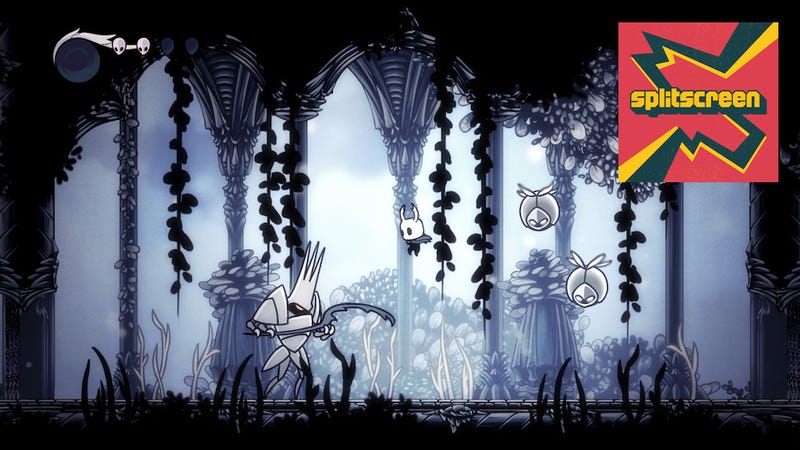
What makes people want to play nails-tough games? When do they risk feeling like a waste of time? On this week’s Kotaku Splitscreen, we discuss.
First, Kirk and I talk about GDQ and hot dog eating contests before getting into all sorts of video game topics like Cyberpunk’s E3 demo audio leaking, Google’s plans for a video game platform, and how the wonderful Hollow Knight has got us thinking about the appeal of tough games.
Listen to the whole episode here:
Get the MP3 here, or read an excerpt:
Kirk: …If I don’t beat [Hollow Knight’s true final boss], it’ll just feel like such a defeat, and I hate that feeling, even while I’m thinking, ‘I could be practicing guitar right now… I could be doing anything except trying this boss fight for the 30th time.’ And I dunno, it’s got me thinking in general about why we take on the challenges in games that are already hard, and the psychology of that and why I feel like I need to do it. Do you get that feeling, when you play really hard games?
Advertisement
Jason: Yes and no, because at a certain point I have to reconcile feeling, ‘I really want to overcome this challenge’ and also ‘How many hours of my life is this going to take, and how many of those hours could I be spending playing something that will be more emotionally enriching or narratively satisfying,’ or something like that. Because you do get certain things out of beating really hard games that you can’t get out of anything else, but you also aren’t getting other things… You aren’t feeling like you’re enriching your life in intellectual ways. You look back and you’re like, ‘Oh my god I just spent 20 hours trying to beat this boss and all I got was that burst of gratification and that’s it.’
Kirk: That cut-scene I could’ve watched on YouTube.
Jason: It almost feels like eating fast food – it’s not nourishing sometimes. Sometimes it does feel nourishing, though.
Advertisement
Kirk: I feel almost like I’m a hamster who’s learned a really complicated light matching pattern. OK, here come the sideways swords, go right, jump, around, over. I have the sound turned way down, and as I take a cooler and cooler approach to the fight, I do better… I’m really good at Hollow Knight now. When I play against regular bosses, it’s just a joke, I feel really fluent at the game, so there’s that. But I agree that there’s this question of diminishing returns – I’m allowing myself to be subjected to this weird science experiment where I’m just trying to learn a bunch of patterns and then flawlessly execute them as my heart rate gradually picks up.
Just this morning I got to the second phase with all of my health, and I was like, ‘Oh my god, oh my god.’ And then adrenaline is cranking through your system, and your heart is beating, and you’re trying to focus, but you can’t keep the distance and remove that you need to match all the sequences and just keep up the constant perfect input you need to do, and it’s a really weird process compared to what most video games demand of you.
Jason: Do you ever think, ‘Oh my god I spent all these hours in Hollow Knight, I could’ve been doing something more enriching’?
Kirk: Yeah… I think that about video games in general.
For much more, listen to the full episode. As always, you can subscribe to us on Apple Podcasts and Google Play to get every episode as it happens. Leave us a review if you like what you hear, and reach us at [email protected] with any and all questions, requests, and suggestions.
Fortnite items have begun to cross over into our world
View Signal Source
Review: The Spectrum Retreat
View Signal Source
A 38-Foot-Tall Whale Made From 10,000 Pounds of Plastic Waste Surfaces in Bruges
In response to the Bruges Triennial‘s 2018 theme “Liquid City,” Brooklyn-based architecture and design firm STUDIOKCA designed a 38-foot-tall sculptural whale composed of over five tons of plastic pulled from the Pacific and Atlantic oceans. The studio, led by Jason Klimoski and Lesley Chang, wanted to address how cities from across the globe are contributing to the waste that has piled up in our oceans—the discarded plastic that is washing up on our shores and endangering and killing marine life. More
Pokemon Go creator’s other main project, Ingress, is getting an anime
View Signal Source
Painted Street Carpets Connect Modern Cities to Ancient Ornamentation by Arthur-Louis Ignoré
Arthur-Louis Ignoré, also known as Ali, paints white patterned carpets on public sidewalks and passageways in cities across the world, including recent installations throughout France and Finland. The works are inspired by both geometric and botanical patterns found in ancient ornamentation from a wide range of cultural contexts. By combining the patterns into public works, he showcases the diversity found in our modern cities while providing a domestic aesthetic that contrasts the often brutalist feel of urban environments. More
This app will send you tiny short stories via push notification
View Signal Source
Researchers create world’s smallest ‘computer’
IBM’s announcement that they had produced the world’s smallest computer back in March raised a few eyebrows at the University of Michigan, home of the previous champion of tiny computing.
What Happens When Your Style Fave Is Problematic?
It’s often hard to separate the artist from their art, and why should we? A lot of the art we…
The post What Happens When Your Style Fave Is Problematic? appeared first on Put This On.
The Brilliant Use of Fear And Scale In Batman: Arkham Asylum’s Scarecrow Levels
The Arkham games are Batman at his best, combining intense action sequences against an iconic gallery of villains with exploration elements via his detective skills. The dark knight isn’t just about brute force, but uses his intellect to gain an advantage over criminals.
I loved soaring through Arkham City and reliving Batman’s past through Arkham Origins. But Arkham Asylum still remains my favorite, in large part, because of the confrontation with Scarecrow.
Advertisement
As part of my ongoing series examining some of my favorite levels in gaming, I want to delve into how Scarecrow’s nightmare sequences were a chilling and unique foray into the fractured psyche of Batman.
Fear The Thong
Batman’s journey into the madness of Arkham Asylum begins, as in most cases, with the Joker. The Joker takes over the asylum and unleashes the inmates to gang up on Batman. Scarecrow, the master of fear, is one of his cohorts.
Advertisement
The first nightmare begins when you confront multiple patients gripped by terror thanks to Scarecrow’s fear gas. They’re shielded off by a glass wall, but Joker taunts Batman throughout this segment and asks a poignant question, “Tell me, Bats, what are you really scared of?”
Is it failing to save the city or not saving Commissioner Gordon? Joker asks. Or is it, “Me in a thong?” Joker suggests as he bursts into maniacal laughter.
The second of the scenarios seemingly comes true. Batman finds Commissioner Gordon, but he’s already dead. “I’m sorry Jim,” he laments. But we, the players, get a sense something is awry as the shadow of Scarecrow pops up behind Batman before quickly vanishing. The dark knight tries to call Barbara to tell her the sad news about her father, but is told the number he dialed isn’t available. The whole pathway to the Morgue starts to fall apart and bricks fall out of the walls. Roach-like blobs scatter and the sinister morgue is coldly empty when you enter. Batman turns around to exit back out to the hallway, but instead enters another Morgue room and starts hearing voices in his head (never a good sign). There are three body bags and the first he unzips is of his father.

“You should have stood up to him, son, like a man,” his father accuses him.
In the second, his mother please, “Help us, Bruce. Don’t let us die.”
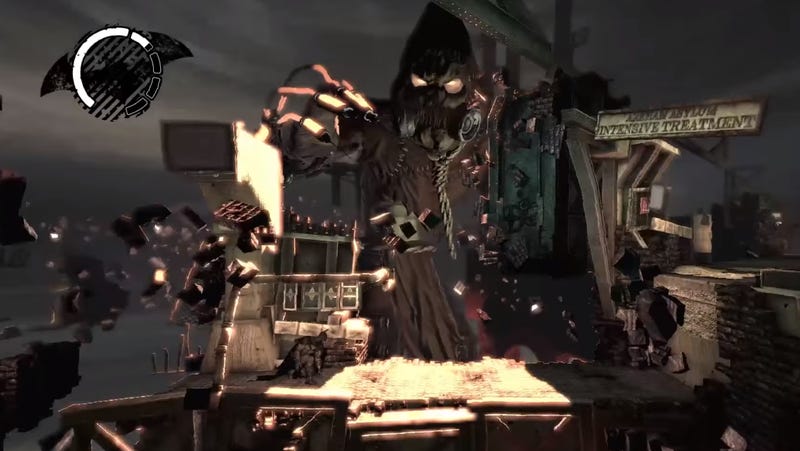
The morgue transforms into a surreal nightmare. Parts of Arkham have been ripped out of place, hovering above a bottomless abyss. Scarecrow is enormous, wielding syringes as fingers, and wearing a gas mask with bright damning lights attached to his goggles as he scours the landscape for Batman.
Advertisement
What does Batman fear? Joker earlier asked. We get a glimpse of it firsthand. The whole landscape is a twisted castle of decrepitude and Batman’s knighthood is being barraged by the overbearing monolith of the Scarecrow. Surprisingly, Batman doesn’t react in horror or shock when faced with these hallucinations. He acts as though this were business as usual. Scarecrow taunts him, “Poor little bat, you’re in my world now.” But this is actually Batman’s mind.

Scarecrow’s lights are blinding and deadly, leading to an immediate gameover if he spots you. Metaphorically, this seems to imply illumination is one of Batman’s greatest fears. Not about getting caught by Scarecrow, but exposing what he feels is his greatest sin. Failing his parents.
Advertisement
To this day, their death haunts him. Batman, in many ways, tries to avoid their accusations using his equipment, hiding where he can, and warily navigating the bizarre landscape that’s as damaged and torn apart as he is. His psyche is a mental maelstrom that wracks him and pounds him with furious guilt. Without a single word of narrative, we learn how twisted Bruce Wayne is deep down.

Just as light can kill Batman, pointing a light back at the Scarecrow with the symbol he hides behind, the Bat, helps wake him. The player would like to comfort themselves with the thought it was just an illusion. But the reality is that it was a manifestation of Batman’s true self.
Clocktower Of Regrets
Two more encounters follow, each with a different focal point of Batman’s fear.
The second encounter begins in his memories of Wayne Manor. It’s raining indoors, lightning flashes, and an interminable hallway turns into the old Crime Alley. Voices replay of the night his parents were killed. Outwardly, he remains stoic, just as an emotional war rages chaotically within. Only when he sees his parents on the ground does his movement stagger. He stumbles to the ground, reliving the biggest trauma of his life.

He is a kid again, remembering what Jim Gordon had said to him after their death. He asks Gordon why his parents were killed, and Gordon, the face of authority, well-intentioned as he is, has no answer. That’s when he turns back into Batman again. It’s not an answer to his parent’s death. Rather, a reaction, trying to impose order and meaning into their meaningless deaths.

The giant Scarecrow is back. The wind howls, mourning music rings. Scarecrow searches the ruins, his psychedelic voice amplified by terror. Reanimated corpses attack Batman. He jumps through his floating archipelago of sorrow. Gears are floating in air, rotating like clockworks representing his desire to turn back time. “There’s no escape,” Scarecrow states, possibly as a threat, but more as a description of Batman’s unceasing remorse. The end is similar to the first.
Advertisement
In the third and final sequence, history is changed and the opening cutscene for Arkham Asylum is reversed. The Joker is in the Batmobile and Batman is the one locked up where Joker had been. “Batman may be escaping patient,” one sign warns. The head of security suggests inmates visit www.Ithinkimgoingcrazyanddresslikeabat.com if they have questions. The Joker ends up shooting him in the head. Game over. There’s even a hint suggestion: “Use the middle stick to dodge Joker’s gun fire.”

When the players continues, Batman rises from his own grave, inside the nightmare again. There are multiple projections of Batman in a mad and deranged state. Another Batman is savagely eating a rat on the ground in a pose reminiscent of one of my favorite Dark Knight story arcs, Venom.
Advertisement
Batman’s conflict with his own sanity and despair are warping his consciousness. Joker and Scarecrow both suggest his place is in the Asylum alongside them. Batman rejects their intimation, but the vulnerability exposed through these nightmarish figures shows that his concerns about his own sanity linger. Joker, in many ways, represents a different reaction to the pointless violence of a sick world. Batman fights against it, trying to impose order through the cowl of the bat. The Joker embraces the entropy and revels in making the chaos worse.

“Are you scared to come out and face your fears, Batman?” Scarecrow asks.
The first spotlight causes Batman to break through the delusion, but Scarecrow injects him with more of the fear toxin. This only makes Batman angrier as he battles the skeletons and shoots another beam of light Scarecrow’s way, finally breaking the spell.
Advertisement
“How are you doing this?” Scarecrow demands. “You’ve ingested enough toxins to drive ten men insane. What are you? Why fight it Batman? You’re as crazy as the rest of us.”
In the end, Batman’s anger triumphs over fear, showing how the vigilante deals with his past trauma in a dark metaphor for the inner state of who he really is. It’s level design at its best, telling a story through gameplay while leaving us more disturbed than comforted. Will the Dark Knight ever find inner peace?
Not within the walls of Arkham Asylum.
