

View Signal Source
A new heat engine with no moving parts is as efficient as a steam turbine

Engineers at MIT and the National Renewable Energy Laboratory (NREL) have designed a heat engine with no moving parts. Their new demonstrations show that it converts heat to electricity with over 40 percent efficiency—a performance better than that of traditional steam turbines.
Petition calls for ban of “woo woo”ing at house music gigs


Canadian Supreme Court Rules ‘Curling is a Real Sport’

OTTAWA, ON In a 6-3 decision, the Supreme Court of Canada ruled today that “curling is actually a real sport, eh.” “Weighing all the evidence, it’s quite clear that curling is a sport,” said Judge […]
The post Canadian Supreme Court Rules ‘Curling is a Real Sport’ appeared first on The Daily Bonnet.
Stand in the Sun With Stone Island’s Heat Reactive Capsule

Stone Island is back again with another offering for the Spring/Summer 2022 season. The technical-focused brand’s new heat reactive capsule indulges the elements in an intuitive new way.The offering features two hooded jackets that are crafted from ultra-light nylon fabric, polyurethane film, stretch linen and cotton tela. Coming in shades of orange and blue, what stands out about the pieces is their thermo-sensitive polyurethane fabric that responds to changes in temperature. Embedded in the fabric are micro-encapsulated colored pigment molecules that gradually change as the temperature rises and falls. Specifically, the pieces will change from yellow to orange and from light blue to bluette.Check out the gallery above for a look at the pieces. Retailing for $1,260 USD each, the heat reactive jackets are available now on Stone Island’s website.In related news, WHO DECIDES WAR x DITA’s eyewear collaboration is fit for the streets.
New sales stats show explosive growth for comics and manga in America

Comicsbeat has released a stunning report on the sales of graphic novels and trade paperbacks in 2021 that shows the current strength of the market — especially for manga.
The report’s author, Brian Hibbs, explains: “In 2021, comics thoroughly exploded in a way that almost defies rationality — not only was raw circulation up by nearly 70% (!), more comics material was sold in 2021 than 2018 and 2019 combined (!!) If we compare the 2021 sales to our first BookScan report in 2003, there’s more than a 558% growth in number of copies sold (!!!).
Crazy Karen Puts Up Missing Cat Signs to Try and Steal Her Neighbor’s Cat, Neighbor Finds the Signs and Claps Back
This Karen knows this cat isn’t hers, so why she thought she’d get away with this is bonkers.
Roman Abramovich’s $1 Billion Five-Yacht Fleet Exposed

Roman Abramovich’s $1 Billion Five-Yacht Fleet Exposed
Since the start of Russia’s "special military operation" in Ukraine and the subsequent sanctions levied by the West, the western press (and western authorities) have become obsessed with tracking the luxury assets belonging to Russia’s billionaire class. Italy has already seized hundreds of millions of euros’ worth of yachts and villas, and it’s not the only jurisdiction seizing assets (or preparing to do so).
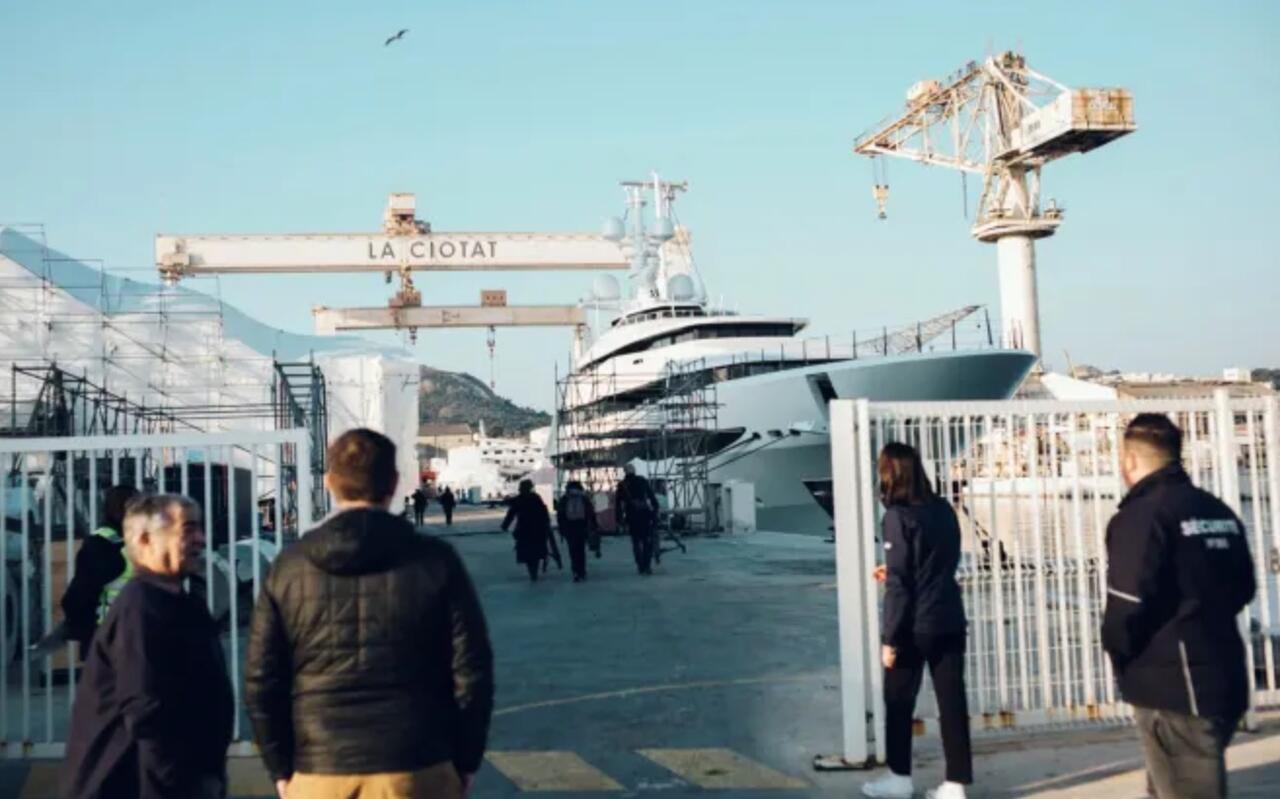
Given his high visibility in the West, it’s perhaps not a surprise that Roman Abramovich’s assets (which, until very recently, included Chelsea Football Club, the popular English Premier League team which he recently placed in the hands of a trust ahead of a sale) have been the focus of particular attention. Two of his yachts ended up in Turkey after fleeing European sanctions.
Now, an investigation by the FT has managed to pierce the veil of secrecy surrounding Abramovich’s assets, and as it turns out, the two megayachts mentioned above represent only a part of his fleet.
The Solaris and Eclipse (worth $474 million and $437 million, respectively) are safely in Turkey. But the FT has discovered that the Russian billionaire also owns the Halo and Garçon, which are both presently moored in Antigua, leaving them within the reach of European authorities.
Per the report, the Antiguan government was unaware of his ownership of the luxury vessels docked on the island prior to being informed by the FT.
This opacity of ownership, a common theme that authorities have confronted in seeking to track down assets owned by sanctioned individuals (while Abramovich has been sanctioned by the EU, Washington has so far held off, purportedly at the urging of Ukrainian President Volodymyr Zelensky), illustrates just how difficult it can be to find and seize oligarchs’ assets.
According to the FT, both Halo and Garçon, valued at $38 million and $20 million, respectively, and are now at risk of being seized.
In a letter to the British high commissioner to Barbados regarding the yachts, Antiguan minister of foreign affairs Paul Chet Greene said the island would “provide full assistance to the government of the United Kingdom” if it receives a request under the two nations’ Mutual Legal Assistance Treaty.
The letter noted that Antigua had requested information on the company that owns the two boats – British Virgin Islands-registered Wenham Overseas Limited – after "persistent allegations by the Financial Times that the vessels could be owned by Mr Roman Abramovich." In response, the British high commission provided Antiguan authorities with a letter, seen by the FT, "from the Financial Investigation Agency of the British Virgin Islands which states the beneficial owner of Wenham Overseas Ltd is Roman Abramovich".
What’s more, British authorities also believe Abramovich is the owner of a fifth yacht presently docked in the South of France.
A person with knowledge of Abramovich’s boat collection and documents seen by the FT indicate that the oligarch may also still be the owner of Sussurro, the first yacht he bought in 1998, despite reports he had given it to an ex-wife in a divorce. The person who correctly identified the two yachts in Antigua as belonging to Abramovich told the FT the oligarch still owned Sussurro. The vessel’s owner is listed in maritime registers as Vesuvius International Limited in the British Virgin Islands. BVI documents show this company was deregistered there in 2017. Another Vesuvius International was registered in Jersey the same year.
In total, Abramovich’s fleet of vessels is worth roughly $1 billion. And while the two most expensive yachts are already safely stowed away in Turkey, he will likely need to move fast if he wants to avoid the rest of his fleet from falling into the hands of European authorities.
Tyler Durden
Sat, 04/02/2022 – 11:00
Why The Dropout Succeeds Where Other Scammer Shows Fall Short

Yield Curve Inversions & Media’s Denial Of History
Yield Curve Inversions & Media’s Denial Of History
Authored by Lance Roberts via RealInvestmentAdvice,com,
Yield curve inversion conversations are dominating the media to the point it almost sounds like the start of a bad joke.
“A yield curve inversion walks into a bar. The bartender asks ‘hey, what’s got you down?’”
The conversations are primarily dismissive under the “this time is different” scenario. As noted by Yahoo Finance last week:
“Take a look at the August 2019 inversion. A recession did happen a year and a half later. But it was triggered by a global pandemic — something bond markets could not have possibly foreseen or predicted.”
That isn’t accurate as the recession occurred only 6-months later. Furthermore, the bond market did know there was something very wrong economically as the Fed was engaged in a massive repurchase operation to bail out hedge funds.
As we noted then, all that was required to push the economy into a recession was an “unexpected, exogenous event.” That event turned out to be a pandemic.
Notably, when psychology changes, for whatever reason, the rotation from “risk-on” to “risk-off” will find Treasury bonds as a “store of safety.” Historically, such is always the case during crisis events in markets.
Once again, it is pretty likely investors should not overlook the message from the bond market. Bonds are essential for their predictive qualities, so analysts pay enormous attention to U.S. government bonds, specifically to the difference in their interest rates.
This data has a high historical correlation to where the economy, stock, and bond markets generally head longer term. Such is because everything from volatile oil prices, trade tensions, political uncertainty, the dollar’s strength, credit risk, earnings strength, etc., reflects in the bond market and, ultimately, the yield curve.
Yield Curve Inversions
When it comes to yield curve inversions, the media always assumes this time is different because a recession didn’t occur immediately upon the inversion. There are two problems with this way of thinking.
-
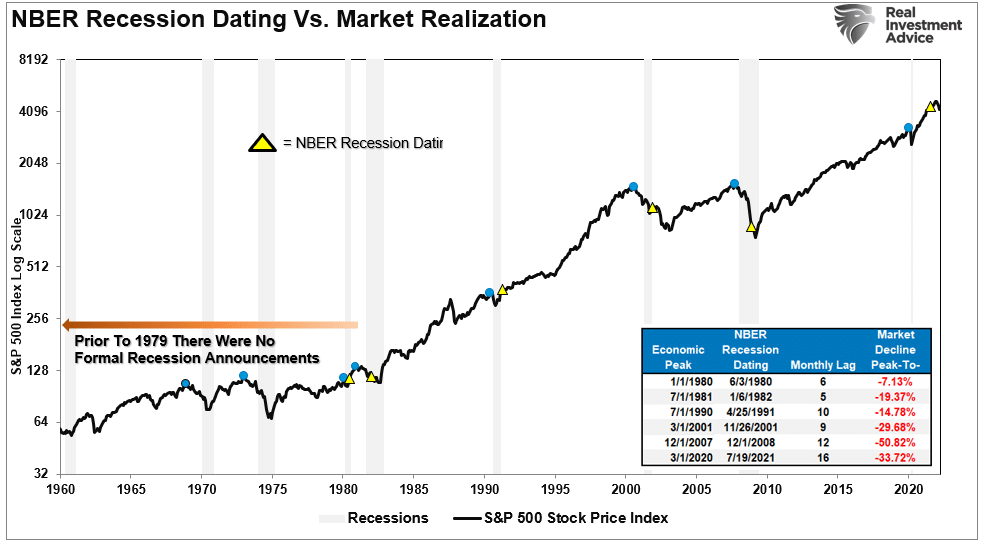
The National Bureau Of Economic Research (NBER) is the official recession dating arbiter. They wait for data revisions by the Bureau of Economic Analysis (BEA) before announcing a recession’s official start. Therefore, the NBER is always 6-12 months late dating the recession.
-
It is not the inversion of the yield curve that denotes the recession. The inversion is the “warning sign,” whereas the un-inversion marks the start of the recession, which the NBER will recognize later.
As discussed in “BTFD Or STFR,” if you wait on the official announcement by the NBER to confirm a recession, it will be too late. To wit:
“Each of those dots is the peak of the market PRIOR to the onset of a recession. In 9 of 10 instances, the S&P 500 peaked and turned lower prior to the recognition of a recession.“
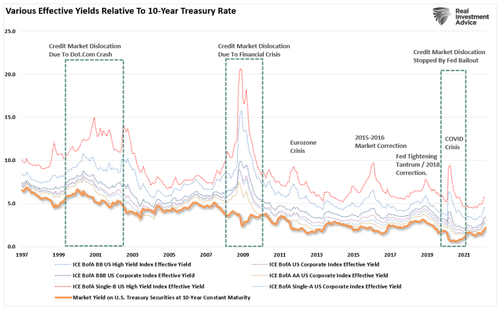
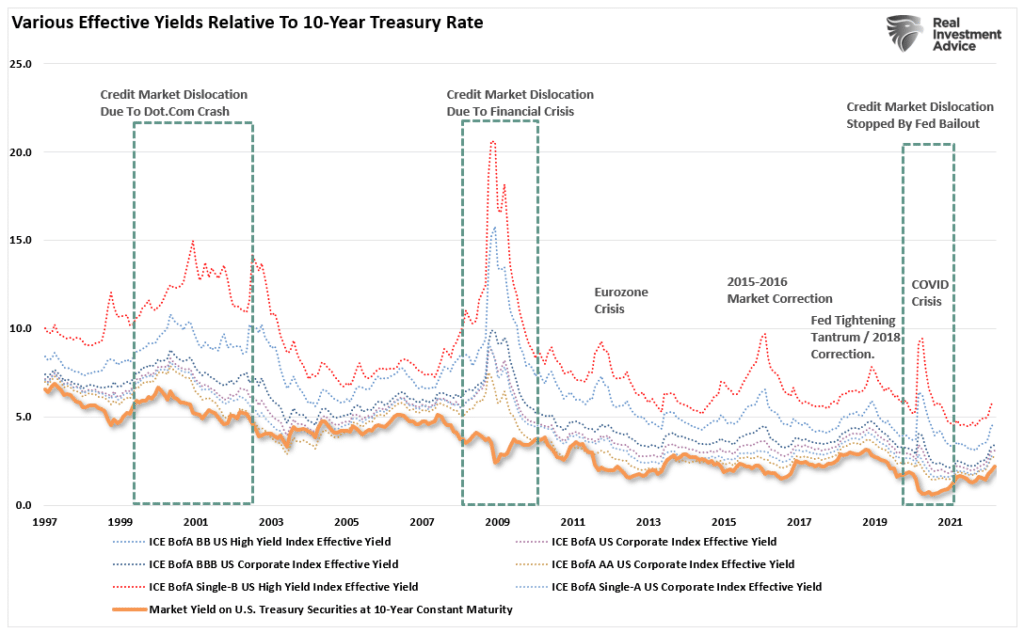
Most of the yield spreads we monitor, shown below, have yet to invert. However, the best signals of a recessionary onset occur when a bulk of the yield spreads turn negative simultaneously. However, even then, it was several months before the economy slipped into recession.
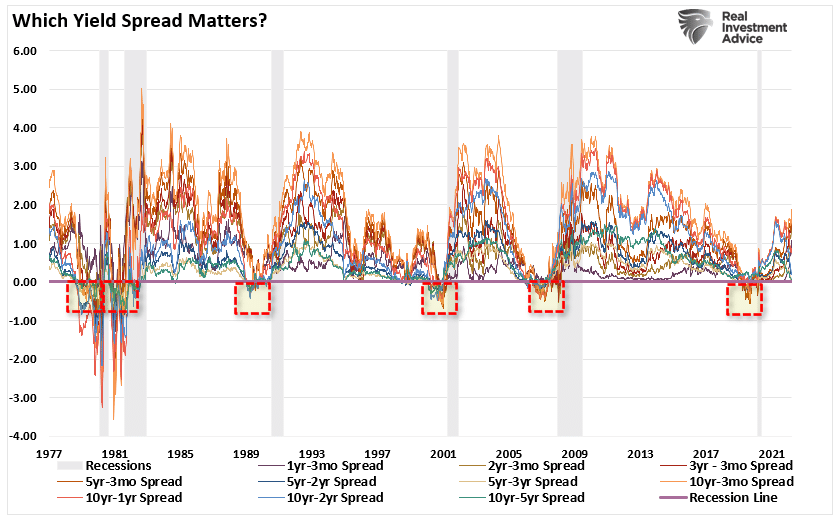
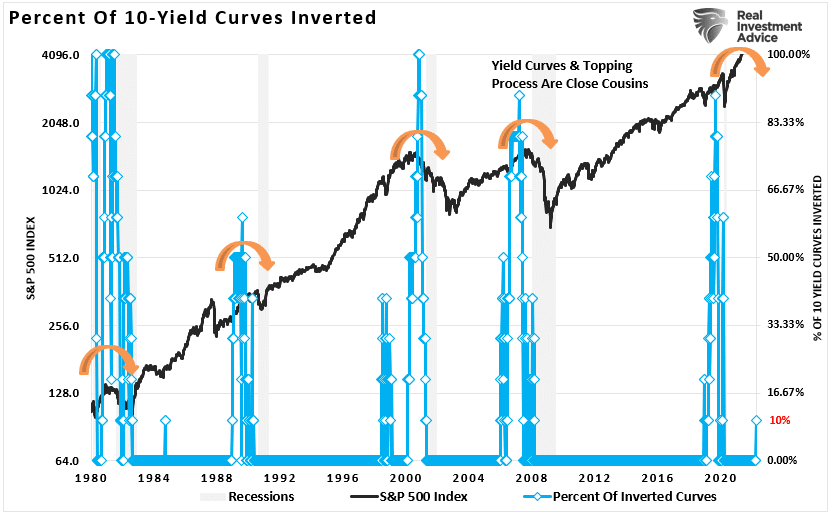
When numerous yield spreads turn negative, the media will discount the risk of a recession and suggest the yield curve is wrong this time. However, the bond market is already discounting weaker economic growth, earnings risk, elevated valuations, and a reversal of monetary support.
Historically, a recession followed when 50% or more of the tracked yield curves inverted. Every time. (Read this for a complete history.)
Ignore At Your Own Risk
In the World War II real-time strategy (RTS) game Company of Heroes, the engineer squad would sometimes say:
“Join the army they said. It’ll be fun they said.”
Since then, the statement has become a common meme on the internet to espouse the disappointment from various actions, from doing the laundry to getting a job.
Well, the latest suggested action, which will ultimately lead to investor disappointment, is:
“Ignore the yield curve they said. It’ll be fun they said.”
In March 2019, Mark Kolanovic of J.P. Morgan stated:
“Historically, equity markets tended to produce some of the strongest returns in the months and quarters following an inversion. Only after [around] 30 months does the S&P 500 return drop below average,”
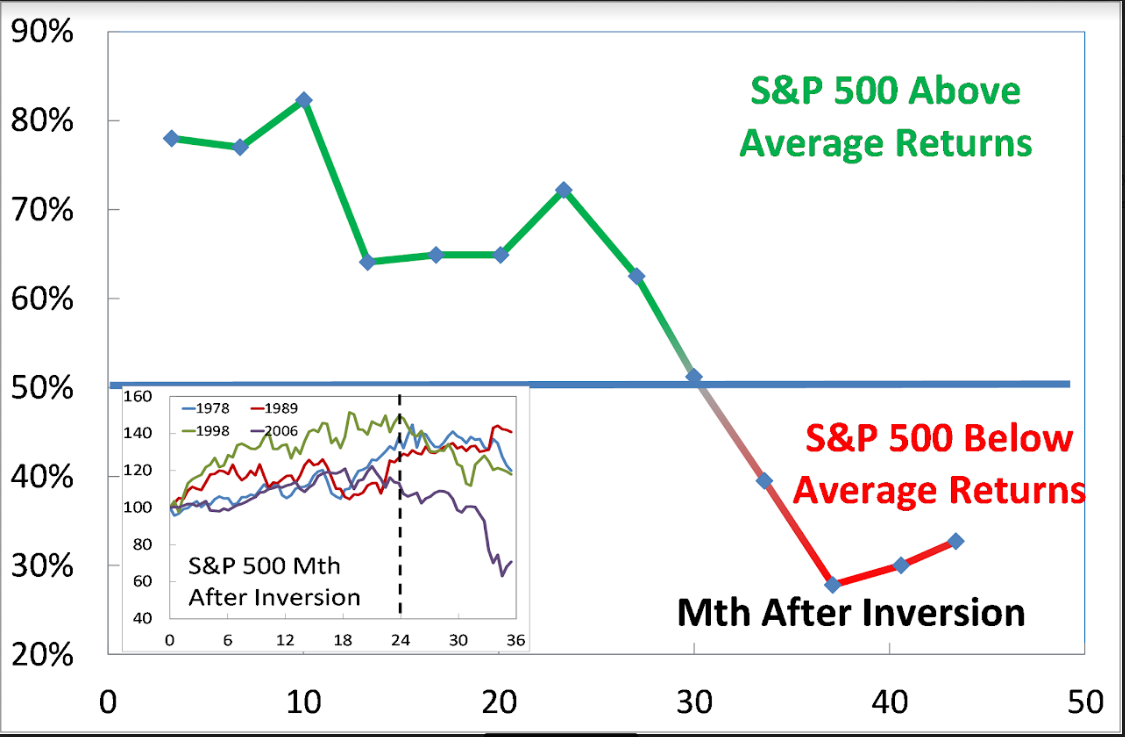
12-months later, the market was down 35%, and the economy was in the deepest recession since the “Great Depression.”
The yield curve is sending a message that investors should not ignore. Furthermore, it is a good bet that “risk-based” investors will likely act sooner than later. Of course, the contraction in liquidity causes the decline, which will eventually exacerbate the economic contraction.
Despite commentary to the contrary, the yield curve is a “leading indicator” of what is happening in the economy currently, as opposed to economic data, which is “lagging” and subject to massive revisions.
More importantly, while the consumer may be continuing to support growth currently, such can, and will, change dramatically when job losses begin to occur. Consumers are fickle beasts, and it will happen very rapidly when a change in psychology occurs.
While using the “yield curve” as a “market timing” tool is unwise, it is just as foolish to dismiss the message it is currently sending entirely.
History has not been kind to those that do.
Tyler Durden
Sat, 04/02/2022 – 12:30
The Art of Choosing Love Over Not-Love: Rumi’s Antidote to Our Human Tragedy

"You’ll long for me when I’m gone… You’ll kiss the headstone of my grave… Kiss my face instead!"
Three of James Webb’s four instruments are now aligned

The long process of getting the James Webb Space Telescope ready to begin collecting science data continues, and the Webb team has met another goal.
